Use this worksheet to choose website FAQ questions, support each answer and decide where the information belongs. Copy the question record for each candidate. Keep observed questions separate from team suggestions and mark missing evidence honestly.
This is an editable planning artifact, not a customer-research report. The worked flower-shop example is fictional and not_verified. It contains no real business policy or measured search demand.
Define the page and audience
- Page or service:
- Audience and decision they are making:
- Primary next step:
- Content owner and reviewer:
- Source records you are authorized to use:
- Personal or confidential information excluded from this worksheet:
- Review date:
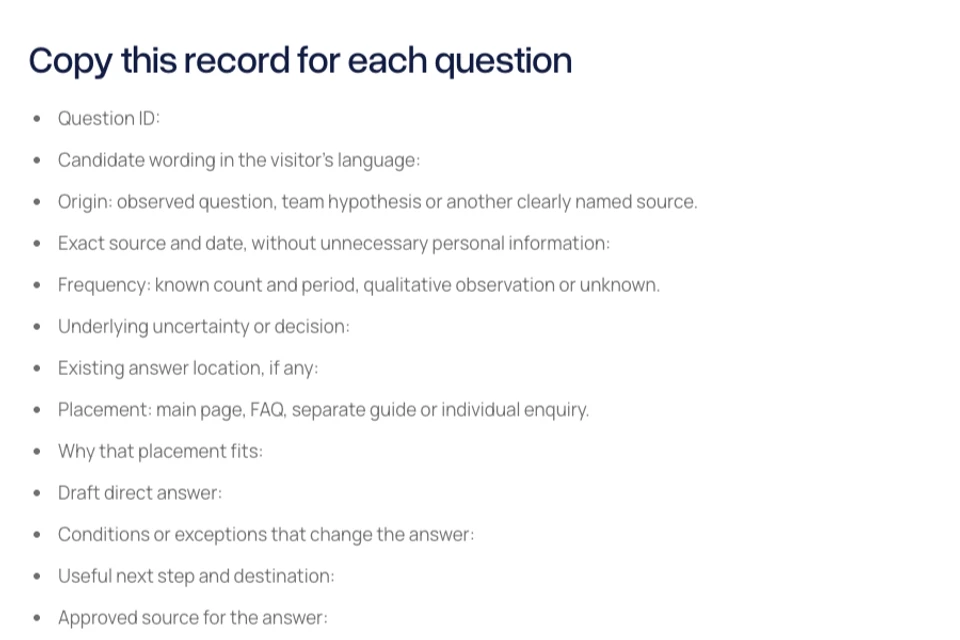
Copy this record for each question
- Question ID:
- Candidate wording in the visitor’s language:
- Origin: observed question, team hypothesis or another clearly named source.
- Exact source and date, without unnecessary personal information:
- Frequency: known count and period, qualitative observation or unknown.
- Underlying uncertainty or decision:
- Existing answer location, if any:
- Placement: main page, FAQ, separate guide or individual enquiry.
- Why that placement fits:
- Draft direct answer:
- Conditions or exceptions that change the answer:
- Useful next step and destination:
- Approved source for the answer:
- Policy or operational owner:
- Public-use approval and reviewer:
- Status: not_verified, needs_revision, approved or withheld.
- Last reviewed and next review trigger:
Fictional worked example
This imagined flower-shop question is an editorial example, not a real enquiry or policy.
- Question ID: DEMO-01.
- Candidate wording: “Can I request a particular flower?”
- Origin: team hypothesis for this fictional exercise.
- Source: none; not observed in customer research.
- Frequency: unknown.
- Uncertainty: whether a preferred flower can be supplied for a particular date.
- Existing answer: not assessed.
- Proposed placement: FAQ after the main ordering information.
- Reason: could address a specific availability exception; needs review against the actual service page.
- Draft answer: “Ask us about the flower and date before ordering; we will confirm what can be supplied.”
- Conditions: actual availability and confirmation process must be supplied by the business.
- Next step: actual approved enquiry route, not yet selected.
- Answer source: missing.
- Owner and reviewer: unassigned.
- Approval: pending.
- Status: not_verified.
- Review trigger: replace with an approved policy before publication.
Do not copy this draft into a real florist’s website without checking the operation. The example demonstrates the record’s boundaries, not an answer you can safely attribute to a business.
Review the answer in context
- The first sentence responds to the actual question.
- Conditions appear before the visitor commits to the next step.
- The answer uses language the audience can understand.
- Claims such as response times have approved operational owners.
- Essential service or price information also appears in the main page where needed.
- Linked policy wording has one maintained source.
- No unsupported testimonial, result or question-frequency claim appears.
- The next-step link works and asks for the right information.
Check the presentation
- Short lists considered for visible headings and answers.
- If an accordion is used, headings and controls have meaningful names.
- Keyboard activation and expanded/collapsed state checked in the actual implementation.
- Focus stays visible and the expanded content remains readable.
- Links inside answers are usable at a narrow width.
- Important information is available where the visitor makes the relevant decision.
- Actual environment, task, result and limitations recorded.
- Anything not checked remains marked not_tested.
A planning record is not evidence that keyboard or accessibility checks passed. Record observed behavior separately from the intended design.
Maintain the published answers
- Final page URL and approved wording:
- Answer owner:
- Last approved date:
- Trigger for review: policy, pricing, service boundary, availability or process change.
- Related pages or summaries that need the same update:
- Retired question and replacement destination, if applicable:
Read the companion useful website FAQ guide. Related primary references are W3C’s accordion pattern and Google’s people-first content guidance. The framework and fictional record are original editorial material, with no ranking or search-feature promise.

The Blitz Studio team
We design brands, build websites and engineer digital products.
Talk about your next project