The quick answer
Before changing a website's URLs, make an old-to-new map that explains where each important destination goes, why that destination is relevant and how the result will be checked. Connect the map to the actual redirect implementation, internal links and post-release ownership. A redesigned homepage alone does not account for old article, product, image or download links.

Before changing a website's URLs, make an old-to-new map that explains where each important destination goes, why that destination is relevant and how the result will be checked. Connect the map to the actual redirect implementation, internal links and post-release ownership. A redesigned homepage alone does not account for old article, product, image or download links.
Agree what is actually changing
A hosting move that preserves public URLs is different from changing domains or page paths. Record the scope before creating redirect rules. Identify the person who owns content decisions and the person who can implement routing in the actual hosting or application setup.
Google's site-move guidance explains preparation for moves with URL changes, including mapping old URLs to their new destinations. Use the source for the applicable technical work, then keep the project's actual decisions in a reviewable record.
This guide focuses on URL mapping and verification. It does not promise unchanged traffic, complete a hosting migration or establish a recovery plan for a particular platform.
Build an inventory that reaches beyond the main menu
Start with the URLs the business already publishes. Use available CMS exports, sitemaps, link records and authorized analytics or server-log evidence. Label the source and date of each input. A sitemap can be useful without proving that it contains every historical destination.
Include relevant downloads and media references as well as pages. An old proposal may link directly to a document, and an image can appear outside the page where the team originally placed it. Decide which assets belong in the move rather than assuming the new navigation covers them all.
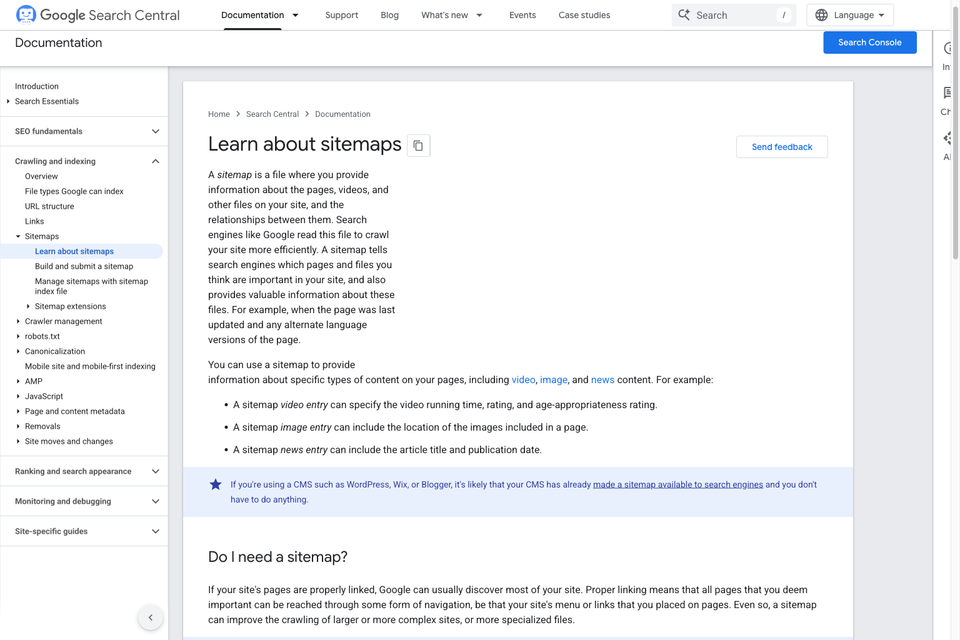
Record priority using actual business importance or observed use when available. An unavailable analytics report is not proof that a URL has no visitors. The sitemap guide explains the limits of discovery evidence.
Choose a destination for a reason
For each old URL, decide whether it stays, moves to an equivalent page, joins a genuinely consolidated destination or is intentionally retired. Name the content owner who can approve that choice. A mapping row with a URL but no rationale leaves an important editorial decision unresolved.
Google advises against sending many unrelated old URLs to an irrelevant destination such as the homepage. If several older pages have genuinely been consolidated into one useful answer, record that relationship explicitly rather than hiding it in a blanket rule.
For a fictional consultancy, an old service explanation might map to an updated page covering the same service. An outdated event page with no replacement needs a separate retirement decision. These are illustrative content choices, not a claim that either route exists on Blitz Studio's website.
Keep redirect behavior and content decisions connected
Google's redirect documentation distinguishes permanent moves from temporary ones. Its site-move guidance recommends server-side permanent redirects for the applicable URL changes and avoiding unnecessary chains.
Ask the implementer to identify where the rule lives, the intended status and the final destination. Check the destination itself, not just the first response. A redirect to a missing or unrelated page is an unfinished mapping.
For intentionally removed content with no suitable replacement, agree the appropriate response. Google's HTTP status guidance explains how missing-content responses are handled. A page that visually says missing while returning success is not the same observation as a real missing-page status.
A real, limited routing observation
On 3 November 2026, we checked one existing Blitz Studio legacy alias: /blog-how-to-create-a-website-on-wordpress.html?ref=migration-example. It returned a direct permanent 308 redirect to the clean WordPress guide path, retaining the query. The destination returned 200 and declared the clean, query-free canonical URL.
This illustrates one verified alias, not a complete historical URL audit or a ranking result. The live WordPress website guide remains at its extensionless public address. The old file-style path is shown here only to explain the observed mapping.
Use the same evidence discipline on a real project: record what was requested, the first response, any hops, the final response and the intended content. Do not infer complete coverage from a few successful samples.
Record parameters, page links and discovery updates
Decide which query behavior the actual task needs and test it. Some parameters affect content; others describe a visit. Document the intended behavior rather than blindly deleting or preserving everything.
Update internal links to the intended current destinations. Check canonical references and sitemap entries against the approved map. Where a project uses additional language or regional annotations, assign their review to an owner who understands that setup.
The internal-link guide supports the visitor paths around the move. A correct server redirect does not by itself update a menu, an old campaign link or a file reference in a published document.
Verify on the public release and keep ownership
Test the map in the intended preview environment, then verify the actual public result after deployment. Keep preview access and indexing settings separate from the public release decision. Record failures and unresolved cases with an owner, then repeat the relevant check after a correction.
Google's move guidance recommends keeping redirects for as long as possible, generally at least a year. That needs operational ownership beyond launch day. Confirm who maintains the old routing infrastructure and who notices when a destination changes again.
Use the migration URL mapping worksheet for decisions and evidence. Keep implementation success, Google processing and business outcomes separate. Authorized Search Console and analytics observations may inform follow-up; publication checks alone cannot establish indexing or stable traffic.
Sources and scope
- Google Search Central: site moves with URL changes.
- Google Search Central: redirects.
- Google Search Central: HTTP status codes.
Sources and the single public routing example checked 3 November 2026. The consultancy example is fictional. This is a planning and verification method, not a completed migration, a full URL audit or a guarantee against traffic changes. The generated cover illustrates storage equipment; it does not demonstrate a verified backup or recovery test.

The Blitz Studio team
We design brands, build websites and engineer digital products.
Talk about your next project