Use this worksheet to draft a website project case study from evidence you actually hold. It separates a design intention, a delivered artifact and an observed outcome so they cannot quietly become the same claim during editing.
Copy the record for each important statement. Keep private analytics, client material and personal information in an authorized internal location; publish only material approved for the public page. This worksheet is an editorial aid, not a measurement study or legal permission form.
Establish the project boundary
- Project name and public naming permission:
- Client or business category, using approved wording:
- Studio contribution and partner contributions:
- Work dates and publication owner:
- Scope delivered, including exclusions:
- Where the approved brief or scope record is stored:
- What must remain confidential:
Copy this record for each claim
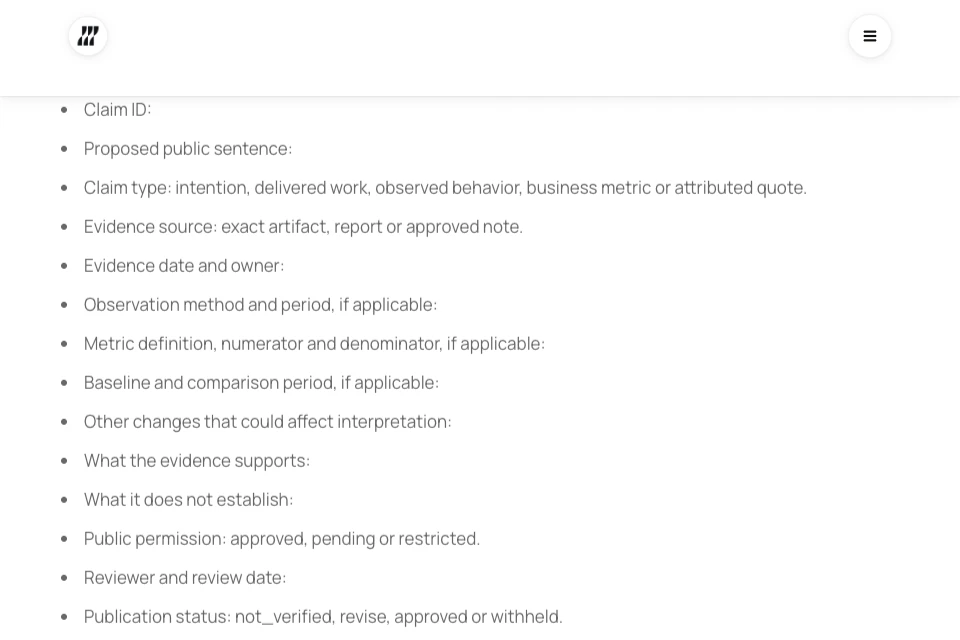
- Claim ID:
- Proposed public sentence:
- Claim type: intention, delivered work, observed behavior, business metric or attributed quote.
- Evidence source: exact artifact, report or approved note.
- Evidence date and owner:
- Observation method and period, if applicable:
- Metric definition, numerator and denominator, if applicable:
- Baseline and comparison period, if applicable:
- Other changes that could affect interpretation:
- What the evidence supports:
- What it does not establish:
- Public permission: approved, pending or restricted.
- Reviewer and review date:
- Publication status: not_verified, revise, approved or withheld.
Worked example: a fictional pricing page
This example describes an imaginary business and contains no research result or actual client claim.
- Claim ID: DEMO-01.
- Proposed sentence: “Setup requirements appear beside the package comparison.”
- Claim type: delivered work.
- Evidence source: fictional approved page design, section named Packages.
- Evidence date and owner: not supplied; fictional example only.
- Observation method and period: visual comparison only; not a visitor study.
- Metric definition: not applicable.
- Baseline and comparison: not applicable.
- Other changes: not assessed.
- What it supports: where the requirements appear in the pictured design.
- What it does not establish: faster task completion, more leads or revenue lift.
- Public permission: pending; replace with actual permission before use.
- Reviewer and date: unassigned.
- Publication status: not_verified.
A publishable version needs the actual artifact and approval. Do not copy this fictional record into a client case study as if a check had been completed.
Plan the visual evidence
- Artifact or screenshot name:
- Original source and location of unique master:
- Source owner and public-use approval:
- Actual capture date, or explicitly unknown:
- Image describes: concept, delivered design or current live page.
- Crop or resizing performed:
- Caption stating the relevant project and visible decision:
- Alternative text appropriate to the surrounding copy:
- Responsive variants and mobile legibility checked:
- Any generated imagery clearly labeled:
Use a crop that makes the specific decision readable. A screenshot demonstrates what was visible in that view; it does not by itself prove accessibility, speed, conversion or current implementation across every device.
Record a measured outcome only when available
- Metric and exact definition:
- Data source and authorized reader:
- Measurement period and timezone:
- Baseline period and comparison rationale:
- Actual values and denominators:
- Qualification or filtering rules:
- Campaign, pricing or traffic changes during the period:
- Attribution limits:
- Client approval for publishing the figures:
If the data are unavailable, write “not measured for this case study” in the internal record. Describe a supported delivery result in the public article rather than estimating an uplift.
Assemble and review the draft
- Context and contribution are specific.
- Problem statement is attributed to its actual source.
- One important decision is explained using a relevant artifact.
- Delivery and measurement are clearly distinguished.
- Every quantitative claim has a definition, period and source.
- Quotes use approved wording and attribution.
- Confidential material and personal data are excluded.
- Images have accurate captions and useful alternatives.
- The page is readable on mobile and its next step works.
- Reviewer, date, remaining limitations and publication decision are recorded.
Keep the record useful after publication
Record the final public URL and the exact published wording of key claims. If a product changes or permission is withdrawn, identify the affected artifact and owner. Review the case study when its facts change; do not update the publication date simply to make unchanged content look new.
Read the companion website project case study guide for examples of bounded outcome language. The prompts and fictional example are original editorial material. Google’s people-first content guidance is useful related reading on sourcing and trust, not a prescribed worksheet or a ranking promise.

The Blitz Studio team
We design brands, build websites and engineer digital products.
Talk about your next project